Most people like to think they are smart with their money. We imagine ourselves as calm, logical investors who buy low and sell high. But our brains often get in the way, turning market ups and downs into an emotional rollercoaster of optimism, euphoria, fear, depression, and regret that can drive poor decisions at the wrong time.
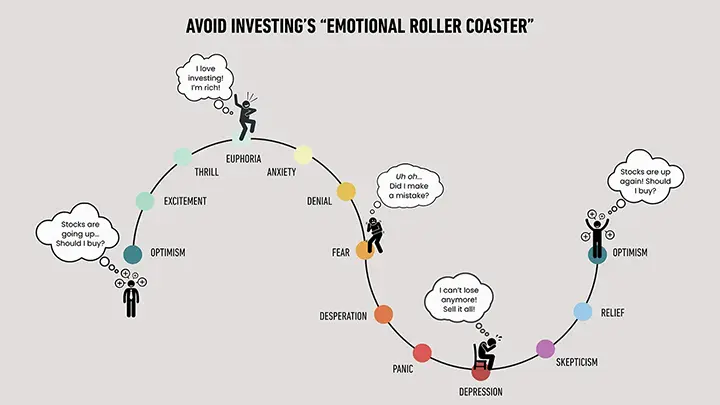
Instead, we are prone to mental shortcuts and emotional traps. These instincts helped our ancestors survive in the wild, but they can be a disaster for your brokerage account and your broader asset allocation strategy.
Here are five common psychological traps and how to avoid them:
1. Anchoring: The Danger of Past Prices
The Problem: Your brain gets “stuck” on the first number it sees. In investing, this usually happens with the price you paid for a stock. If you bought a stock at $100 and it drops to $70, you might refuse to sell until it gets back to $100. You are “anchored” to that original price, even if the company is struggling and the stock’s true intrinsic value is now only $50.
Anchoring often traps investors in denial and anxiety, as they fixate on past prices and wait for emotional relief rather than making decisions based on current facts.
How to Avoid Anchoring: The “Clean Slate” Test
Ask yourself, “If I didn’t already own this stock, would I buy it today at its current price?” If the answer is no, you shouldn’t be holding just because of an old price. This is a core tenet of disciplined diversified portfolio management.
2. Loss Aversion: Fearing the Red
The Problem: The pain of losing money is psychologically about twice as intense as the thrill of gaining the same amount. Researchers have found that humans are wired to avoid the pain of a loss more than we seek the joy of a gain. This leads to the classic investing mistake of “watering the weeds and cutting the flowers.”
Investors would rather hold onto a losing investment for years than admit they made a bad decision. They may be too quick to sell successful investments to lock in small wins while finding it difficult to accept losses and move forward rationally.
How to Avoid It: Reframe “Losses”
Don’t view a realized loss as a personal failure. View it as tuition paid to the market for a valuable lesson. The goal isn’t to avoid losses entirely; it’s to ensure your winners outpace your losers over time within a professional long-term financial plan.
3. Confirmation Bias: The Echo Chamber
The Problem: You prefer to listen to people who agree with you. If you love a certain tech company, you will probably search for articles and videos that talk about how great it is. When you see a report saying the company is in trouble, you might ignore it or dismiss it. This creates an echo chamber where you never hear the risks of your investments.
Confirmation bias feeds optimism while filtering out skepticism, leaving investors emotionally unprepared when reality challenges their beliefs.
How to Avoid It: Actively Seek the “Bear Case”
If you are bullish on a stock, force yourself to find the three best arguments against owning it. If you can’t dismantle those arguments rationally, your conviction might be misplaced.
4. Herd Mentality: The Survival Instinct
The Problem: You want to follow the crowd because you’re afraid of being left out. For millennia, following the crowd was a survival tactic. In the stock market, this instinct can lead you to buy at market tops because “everyone else is getting rich,” and sell at market bottoms because everyone else is panicking.
How to Avoid It: Have a Written Plan
In coordination with your fiduciary advisor, create an Investment Policy Statement that dictates your goals and strategy. When the herd is stampeding, focus on executing your plan rather than reacting to the noise.
5. Overconfidence Bias: The “Above-Average” Illusion
The Problem: Thinking you are better at picking stocks than the experts. Most people believe they are “above-average” drivers, which is mathematically impossible. It’s the same with investing. Casual investors believe they can predict market moves, leading to overtrading and insufficient diversification.
How to Avoid It: Consult a Fiduciary Advisor
A fiduciary advisor is a financial professional who is required to put your interests ahead of their own. An advisor acts like a coach. They keep you grounded when you feel like making a risky bet and help you build a diversified portfolio backed by expert guidance.
Summary: Five Psychological Traps and How to Avoid Them
| The Trap | What it feels like | The Fix |
|---|---|---|
| Anchoring | “I’ll sell once I get back to even.” | Focus on the future, not past prices. |
| Loss Aversion | “I can’t sell now; I don’t want to lock in the loss.” | Learn from your experiences and move on. |
| Confirmation Bias | “I found five articles that agree with my position.” | Seek out the opposing viewpoint. |
| Herd Mentality | “Everyone is buying this; I need to get in!” | Stick to your financial plan. |
| Overconfidence | “I know where the market is headed next.” | Be humble and consult a fiduciary advisor. |
Conclusion: Master Your Investor Psychology
It’s clear that successful investing is about more than just numbers; it’s a disciplined approach to managing your own psychology. By recognizing our inherent biases—whether it’s anchoring, loss aversion, confirmation bias, herd mentality, or overconfidence—you can begin to make more rational, long-term decisions. Don’t let an emotional rollercoaster dictate your financial future.
Take Control of Your Investor Psychology Today
If you are ready for a structured, disciplined strategy backed by expert guidance, we can help. Let us help you build a resilient, diversified portfolio and a clear plan designed for your long-term success.
Reach out to Trajan Wealth today to schedule a complimentary appointment with a fiduciary advisor.