If you’ve followed the news at all in the past year, you’ve probably heard a lot about Artificial Intelligence and its implications for our futures. From curing cancer to replacing the entire workforce, it seems the opportunities (and concerns) surrounding AI are endless. If AI truly is the next revolution, who will be the big winners of this ‘AI gold rush’?
The Infrastructure Behind the Revolution
The rise of massive AI models (the type that can power autonomous vehicles or develop new drugs) demands unprecedented levels of computing power. Creating these models, storing the vast amounts of data they require, and running them on a large scale necessitates a deep physical foundation of technology.
According to McKinsey & Company, global investment in data center infrastructure tied to AI could reach into the trillions of dollars over the coming decade, reflecting the scale of demand required to support these technologies.1
This infrastructure includes advanced semiconductors, networking, storage, and specialized components. These are the “picks and shovels” of the AI gold rush.
Essential AI Hardware
At the top of the AI food chain is the Graphics Processing Unit (GPU), with NVIDIA NVDA and Advanced Micro Devices AMD serving as the primary suppliers. GPUs are indispensable for AI training because they can run many calculations in parallel.2
GPUs are supported by the Central Processing Unit (CPU), a segment of the semiconductor industry historically dominated by Intel INTC and AMD. The CPU acts as the system conductor, organizing data flow and managing the overall system.3
For running trained models efficiently in the real world (a process known as inference), companies often rely on highly customized silicon called Application-Specific Integrated Circuits (ASICs).4 Companies like Broadcom AVGO and Marvell Technology MRVL provide custom silicon for hyperscale data centers.
AI Chip Manufacturers & Tool Suppliers
However, none of these chips could exist without manufacturing infrastructure. Production is typically produced by specialized manufacturing firms known as foundries, led by Taiwan Semiconductor Manufacturing TSM. These foundries rely on highly sophisticated equipment to fabricate cutting-edge chips, and in turn rely on a very specialized group of tool suppliers such as ASML Holdings ASML, Applied Materials AMAT, and Lam Research LRCX.
For example, extreme ultraviolet (EUV) lithography machines are critical to producing the most advanced semiconductors. Reporting from Reuters highlights that only a small number of companies globally produce this equipment, underscoring the concentration and complexity within the semiconductor supply chain.5
Finally, a massive AI cluster requires an intricate plumbing system to manage the flow of data. This includes High-Speed Networking components from companies like Broadcom and Arista Networks ANET to ensure data can move quickly between thousands of GPUs.
These manufacturers, along with equipment suppliers, form a foundational layer of the AI ecosystem.
Key Players in the Semiconductor Space
Companies providing this essential hardware are the indirect benefactors of the AI boom. As AI model builders heavily invest in computing capacity, the demand for semiconductors is soaring.
Valuation
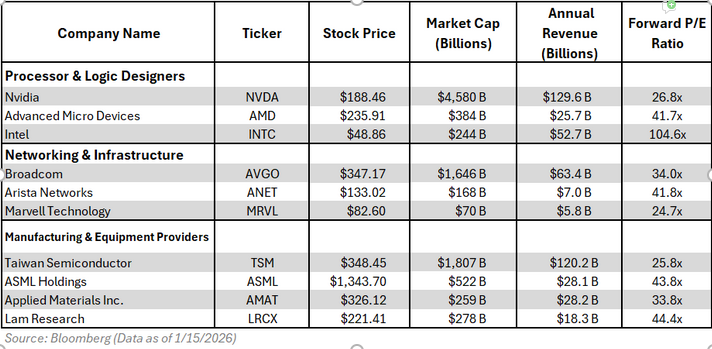
Demand for AI computing remains strong, but much of this optimism is likely already reflected in current share prices. As the table illustrates, forward price-to-earnings multiples of 30x, 40x, or higher are now common across the semiconductor sector. Despite a market capitalization approaching $4.5 trillion, NVIDIA trades at a relatively modest 26.8x forward earnings, which may look attractive on a relative basis. Taiwan Semiconductor Manufacturing also appears fairly valued given its near monopoly in leading-edge chip fabrication. Intel, on the other hand, is valued at over 100x earnings, a figure largely driven by temporarily suppressed profits amid its ongoing turnaround efforts. Ultimately, investors must weigh compelling growth prospects and durable competitive advantages against stretched valuations. It’s worth remembering that owning a great company does not automatically translate into owning a great stock.
Challenges and Future Considerations
The AI buildout is not without its hurdles. Investors must consider various risks that could affect these sellers:
- Power Generation: Running massive AI data centers consumes enormous amounts of electricity.6 The power demand of the latest AI chips is pushing current data center infrastructure to its limits, necessitating investments in high-voltage power management and advanced cooling solutions like liquid immersion cooling. This creates indirect opportunities for industrial suppliers but poses an increasing financial and environmental burden on the large tech buyers.
- Return on Investment: The cost of building and maintaining advanced computing infrastructure is significant. For the semiconductor industry, maintaining the lead in chip technology requires staggering R&D and capital spending on new fabrication plants (fabs), with some new fabs costs upwards of $20 billion.7 This financial pressure is compounded by the global competition for talent and the long lead time to bring new manufacturing capacity online, creating a persistent risk of supply-chain bottlenecks and cost overruns.
- Regulatory Risks: Governments worldwide are beginning to scrutinize the development and deployment of AI technology. Specifically, geopolitical tensions lead to export controls on the most advanced chip technology (like high-end GPUs and ASML’s machines), creating market fragmentation and forcing companies to design distinct supply chains for different regions, which adds complexity.8 Furthermore, scrutiny over data centers’ environmental impact may lead to new energy consumption regulations.9
Conclusion
The AI gold rush is transforming the tech landscape. As the development of advanced AI models continues to require ever-increasing computational power, the demand for GPUs, specialized ASICs, manufacturing tools, and advanced foundries will only grow. For investors, the question remains: While the spotlight shines on the gold, who is best positioned to make money from the shovels?
Is Your Portfolio Ready for the AI Revolution?
In periods of technological disruption, disciplined portfolio construction matters more than headlines. At Trajan Wealth, we focus on separating durable fundamentals from speculation. If you would like to discuss how themes like artificial intelligence fit into a broader, risk-aware investment strategy, contact a Trajan Wealth fiduciary advisor today!
Sources:
- https://www.mckinsey.com/industries/technology-media-and-telecommunications/our-insights/the-next-big-shifts-in-ai-workloads-and-hyperscaler-strategies
- https://www.ibm.com/think/topics/gpu
- https://www.amd.com/en/blogs/2026/agentic-ai-brings-new-attention-to-cpus-in-the-ai-data.html#:~:text=Training%20is%20where%20GPUs%20and,This%20shows%20why%20architecture%20matters
- https://www.synopsys.com/glossary/what-is-asic-design.html
- https://www.reuters.com/world/asia-pacific/asml-plots-future-chipmaking-tools-ai-beyond-euv-2026-03-02/
- https://www.mckinsey.com/industries/technology-media-and-telecommunications/our-insights/the-next-big-shifts-in-ai-workloads-and-hyperscaler-strategies
- https://www.z2data.com/insights/where-are-all-the-north-american-semiconductor-fabs-being-built-2024#:~:text=Together%2C%20the%20two%20fabrication%20plants,based%20in%20Washington%20and%20China)
- https://ai-frontiers.org/articles/us-chip-export-controls-china-ai#:~:text=That%20shift%20reflected%20a%20growing,tools%20and%20chips%20to%20China
- https://stateline.org/2026/02/05/with-electricity-bills-rising-some-states-consider-new-data-center-laws/