Elections stir strong feelings, but they’re an unreliable guide for investment decisions. Since 1949, the S&P 500 has delivered strong returns through 14 presidents and nearly every mix of party control, turning $1,000 into about $6.28 million. Vote your convictions at the ballot box, but let your financial plan guide your portfolio.
Politics and Your Portfolio
On Nov. 3, voters will decide every seat in the House of Representatives and about a third of the Senate. Control of Congress is up for grabs, campaign ads are everywhere, and many investors are wondering what it all means for their money.
It’s a fair question. Elections shape tax policy, spending, and regulation. The stakes are high. But history offers a reassuring answer: Over the long run, the stock market has rewarded investors, no matter who was representing them in Washington.
What History Teaches Us
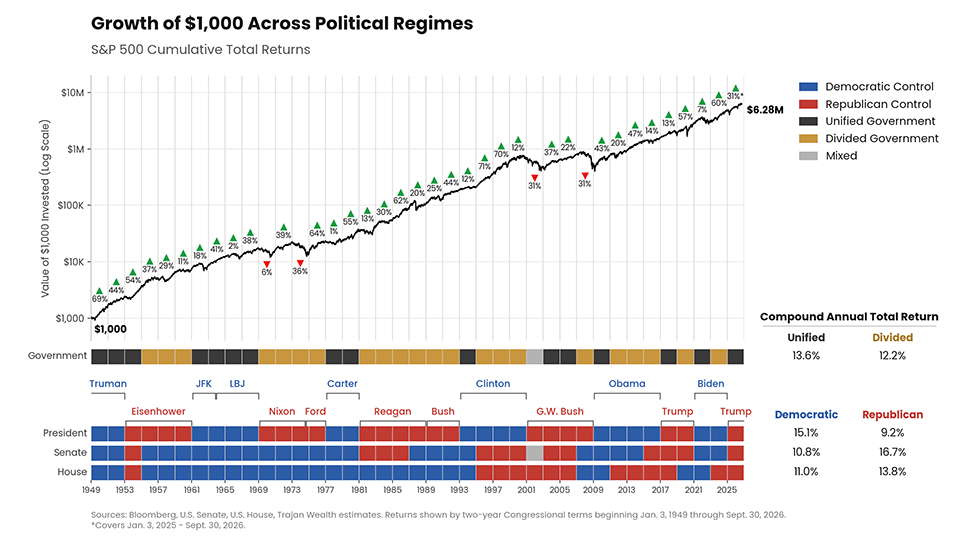
The chart above shows the growth of $1,000 invested in the S&P 500 at the start of 1949, with dividends reinvested, through Sept. 30, 2026. The bands along the bottom indicate which party controlled the White House, Senate, and House during each two-year term of Congress. The top band is black when one party held all three branches of government, and gold when control was split (divided government).
As you can see, the market tends to go up under both Republican and Democratic presidents, Republican and Democratic Congresses, and nearly every other combination. An original investment of $1,000 grew to about $6.28 million, a compound annual total return of 11.9%.* Stocks rose in 35 of the 39 two-year terms during this time period.*
No Party Has a Monopoly on Market Gains
To the right of the chart, you can find returns by branch of government and political party. It’s a mixed picture. Stocks have historically done better under Democratic presidents (15.1% per year vs. 9.2% under Republicans), mostly because of poor returns during the Nixon, Ford, and George W. Bush administrations. However, control of Congress had the opposite effect: Returns were higher with a Republican Senate (16.7% vs. 10.8%) and a Republican House (13.8% vs. 11.0%).* The gap between unified and divided government was relatively small (13.6% vs. 12.2%, in favor of unified).*
In other words, party control is not a reliable predictor of stock market returns. There are too many other factors at work — the economy, technological change, wars, consumer sentiment — for politics to have an outsized influence. If there are 1,000 different factors driving the market on any given day, week, or year, politics is just one of the 1,000.
Politics Can Color How We See the Economy
Part of the challenge is that political views shape our economic expectations more than we realize. The University of Michigan’s long-running Surveys of Consumers has tracked this for years.
For example, around the 2016 Presidential election (won by Republican Donald Trump), the share of Democrats expecting unemployment to rise jumped from 12% to 41%, while the share of Republicans expecting the same fell from 41% to 7%. After the 2020 election (won by Democrat Joe Biden), the pattern flipped: Consumer expectations rose sharply among Democrats and plunged among Republicans.
In both elections, pessimism proved costly. The S&P 500 returned 23.7% in the 12 months after the 2016 election and 40.3% in the 12 months after the 2020 election.*
The Cost of Investing Along Party Lines
Some investors are tempted to get out of the market when the “other side” takes power. History shows how expensive that can be.
Imagine two investors who each started with $1,000 in 1949. The first owned the S&P 500 only when a Democrat was president, and stuffed their money under a mattress the rest of the time. The second did the same with Republican presidents. By Sept. 30, 2026, the Democrat would have about $159,000. The Republican would only have about $40,000. Meanwhile, an investor who simply stayed invested through the full period would have $6.28 million.* Vote with your ballot, not with your wallet!
Vote Your Values, Invest with a Plan
Caring about politics is a good thing — we need more engaged citizens. But your investment portfolio should reflect your long-term financial goals, your time horizon, and your risk tolerance. None of those changes on election night.
That doesn’t mean ignoring Washington entirely. For example, changes to tax law should be discussed with your financial advisor, estate advisor, and tax advisor. For Trajan Wealth clients, all three of these services are available from our in-house team of experts, who work together to build your personal, coordinated plan.
When in Doubt, Talk It Through
If the election has you thinking about a big change to your investments, call your fiduciary advisor first. A good advisor can help you separate your long-term plan from the noise of campaign season.
Markets have grown through every kind of political landscape. If you’d like a partner to help you stay focused on achieving your financial goals, contact Trajan Wealth.
*Bloomberg, Trajan Wealth Estimates. Returns reflect the S&P 500 total return with dividends reinvested. Hypothetical examples assume no taxes or fees. Future returns could differ materially from historical results.